
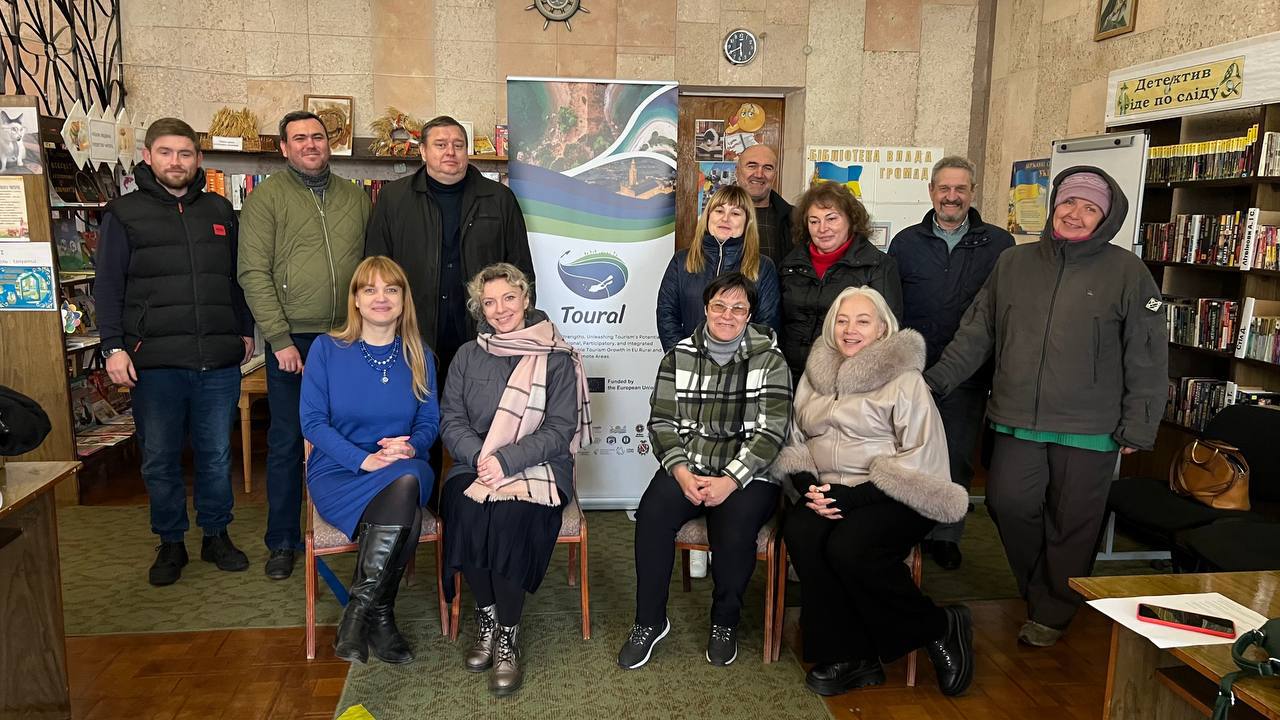
On November 15, the Kutsurub community hosted a working meeting of the international TOURAL project participants with representatives of the local community, business, and government. This meeting marked the beginning of efforts to implement one of the project’s key stages—the “Living Lab.” “Living Lab” serves as an interactive environment for collaborative work among representatives of all population groups involved in developing the Kutsurub community’s tourism industry. As part of the project, several regions have been identified for international cooperation to promote sustainable tourism development:
- Region 1: Northern Sporades (Greece)
- Region 2: Teramo Province (Italy)
- Region 3: Pag Island/Simuni Village (Croatia)
- Region 4: Nesebar (Bulgaria)
- Region 5: Danube Delta LAG (Tulcea, Romania)
- Region 6: Kutsurub Rural District (Ukraine, Mykolaiv Region, Kutsurub Territorial Community)
Located on the Black Sea Lowlands, the Kutsurub community is characterized by a flat plain traversed by ancient ravines. The area boasts significant natural resource potential, driven by its mild microclimate with therapeutic properties, preserved sections of virgin steppe, and vibrant historical heritage, making it a promising region for development. The unique natural environment of steppes, meadows, ravines, and proximity to the Dnipro-Bug estuary fosters high biodiversity, including rare bird species. Particularly notable is the Adzhigol Ravine, a valuable protected area within the Emerald Network.
The Kutsurub community is also part of Ukraine’s rich cultural heritage, housing the remnants of a Scythian-Hellenic settlement surrounding the ancient Greek polis of Olbia.
Kutsurub has substantial recreational and tourism potential. Before the war, the community offered:аpproximately 50 accommodation facilities; оver 50 dining establishments; numerous cultural and historical sites, including the National Historical and Archaeological Reserve “Olbia,” archaeological landmarks (fortress remnants, burial mound groups), and museums.
Nearby, the Ochakiv community complements the region’s tourism appeal with natural reserves, such as the Biloberezhia Svyatoslava National Nature Park and the Kinburn Spit Regional Landscape Park, which can enhance tourism services.
This combination of historical, cultural, and natural assets positions the Kutsurub community as a prime destination for sustainable tourism development within the TOURAL project.
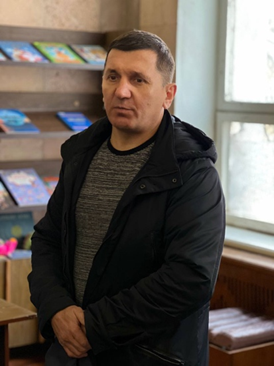
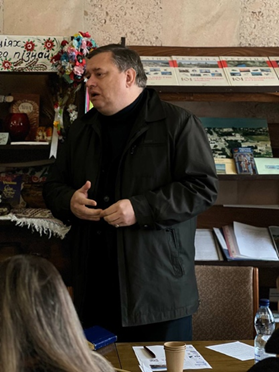
The meeting with community representatives was attended in person by Diana Krysynska, TOURAL Project Manager, and Inna Tymchenko, an ecology and community engagement expert from the National Ecological Centre of Ukraine team.
During the meeting, Diana Krysynska presented the TOURAL project and its interim results. In her speech, she highlighted the challenges facing the rebuilding of the tourism sector in the Kutsurub community: Severe damage to infrastructure and the environment caused by the Russian military invasion; Poverty in rural areas; Lack of knowledge and experience in entrepreneurship; Absence of a systematic approach to tourism development (national, regional, and local levels); Underdeveloped tourism infrastructure; Limited tourism services and restricted access to them; Remote location and poor road conditions.
The presentation outlined the expected outcomes of the TOURAL project for the Kutsurub community:
- The team will study sustainable tourism practices from other macro-regions to develop a regional development strategy and reimagine local material and intangible cultural heritage.
- Efforts will focus on preserving the region’s natural and cultural heritage.
- Identifying stakeholders and raising awareness about proper business and tourism practices.
- Establishing a structured approach to sustainable tourism growth.
- Developing a roadmap to enhance rural tourism potential and provide actionable steps for implementation.
The meeting emphasized the importance of collaborative efforts to overcome challenges and unlock the tourism potential of the Kutsurub community.
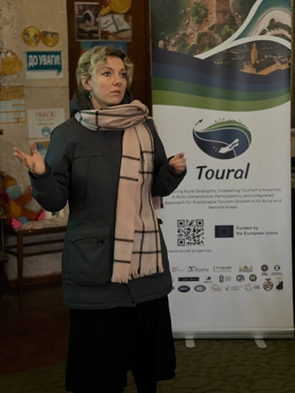
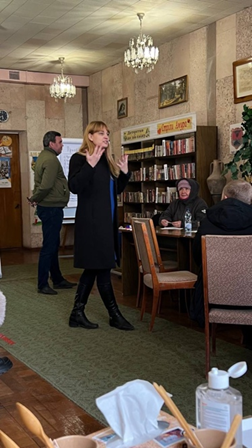
Inna Tymchenko spoke about the region’s unique assets, emphasizing those located within the community. She stressed the importance of their development and proposed actionable pathways to achieve this goal
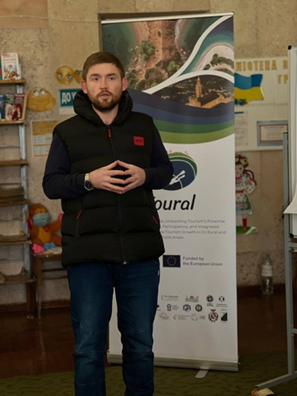
Among the representatives of the NGO “Kinburn” were Mykola Hrubyi, the head of the organization, and Ruslan Volchetskyi, a tourism and recreation expert, manager of the Ukrainian Association of Business Support Centers, and head of the Youth Tourism and Local History Club “Saint Nicholas.” Mykola Hrubyi highlighted the prospects for collaboration between the NGO “Kinburn” and the Kutsurub community within the framework of the project.
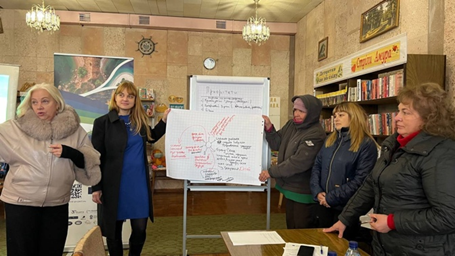
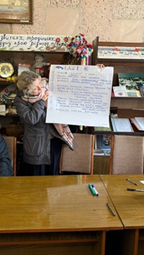
During a facilitation session led by Ruslan Volchetskyi, participants worked in two teams to address challenges and prioritize directions for tourism development in the Kutsurub community. The key challenges identified included an imperfect legislative framework, a lack of informational support to promote tourism in the region, underdeveloped infrastructure, and the impact of ongoing military actions, as the community remains within an area of active combat. Additionally, the lack of investment and funding for the tourism sector was highlighted.
The participants outlined several priorities for tourism development in the community, including support for local businesses and a focus on developing cultural, gastronomic, event-based (festival), water, scientific, rural (ecological), and recreational (beach) tourism. Other suggestions included creating and selling souvenir products and organizing pottery workshops.
Various ideas for tourism development emerged during the team discussions. One notable proposal from local residents was the creation of themed guesthouses, such as “Fisherman’s Cottages,” leveraging the region’s rich fishing resources to promote recreational fishing as a potential growth area for the community. Svetlana Taraban, a local resident, emphasized the importance of this idea.
Community members also shared insights into locally produced goods, such as wine and organic products. However, many residents lack the skills to advertise their products or manage social media effectively—skills that could significantly support small business development.
Yevheniia Sylaieva, a resident of the village of Parutyne, stressed the importance of workshops, training sessions, and various courses for the community, particularly in media literacy, personal branding, and promoting tourism products via social media.
Participants also proposed organizing events such as:
- Gastronomic festivals featuring historical local cuisine, traditional dishes, winemaking, and wine tastings.
- Ecological routes and sports competitions like the “Olbian Olympic Games.”
- Water-based tours utilizing local water transport and guides.
Military tourism, integrated as a quality component of the broader tourism product.
After a fruitful discussion, the participants concluded that expert training is needed to promote tourism products through mass media, alongside creating a regional branding strategy to enhance the area’s identity.
Petro Mahalias, the owner and director of OLBIO NUBO, joined the working meeting. The brand focuses on reviving ancient winemaking techniques while developing and promoting the region’s wine traditions.
The event also included remote participation by the Bakhtov family of artists, who expressed their interest in fostering creative and artistic tourism initiatives in the region.
Representatives of the National Historical and Archaeological Reserve “Olbia” were also present, emphasizing the importance of developing modern, interactive methods for conducting tours.
As part of the project, the team conducted a survey to gather insights from local residents about their vision for future collaboration to restore the tourism sector in the Kutsurub community, guided by the principles of sustainable tourism.

The event was held as part of the TOURAL project—“A Multidimensional Model of Tourism Verticals Promoting Sustainable Balanced Growth among Rural and Remote Networks and Urban Clusters of Rural Regions, Facilitating Macroregional Cooperation”—funded by the European Union.
The views and opinions expressed herein are solely those of the author(s) and do not necessarily reflect the position of the European Union. Neither the European Union nor the granting authority is responsible for them.
Authors of the text: Veronika Popova, Diana Krysynska, Inna Tymchenko.
Photographic materials: Anna Kosmachova.

© European Union, 2023
This project has received funding from the European Union’s Horizon Europe research and innovation programme under grant agreement No. 101133983. Views and opinions expressed are however those of the author(s) only and do not necessarily reflect those of the European Union. Neither the European Union nor the granting authority can be held responsible for them.