

The National Ecological Centre of Ukraine (NECU) has developed a simple, reliable, and effective tool for monitoring sediments in the Danube River as part of the SUNDANSE project – an innovative sediment management concept for a sustainable Danube–Black Sea system.
This suspended sediment trap enables:
- Detailed study of the spatial and temporal characteristics of sediment flows;
- Detection and assessment of pollutant content (including microplastics);
- Sample collection under various hydrological conditions – easily, safely, and cost-effectively.
The ease of manufacturing, use, and transportation makes this device indispensable for field research. A video demonstrating the trap’s operation is available here: https://www.youtube.com/shorts/m5ddNgphmkY
The use of sedimentation traps for studying suspended matter in rivers was highlighted in the report “Sedimentation Traps as a Tool for Studying River Suspended Matter in Water Quality Control and Sediment Management” at the International Conference on Natural Hazards Monitoring, held on April 14–17, 2025, at the Institute of Geology, Taras Shevchenko National University of Kyiv.
The report’s authors – Ye. I. Nasedkin, R. B. Havryliuk (Institute of Geological Sciences of the National Academy of Sciences of Ukraine, NECU, Kyiv), G. M. Ivanova (Institute of Geological Sciences of the NAS of Ukraine, Kyiv), S. G. Fedoseenkov, O. I. Shundel (State Institution “Scientific Hydrophysical Centre of the NAS of Ukraine, Kyiv), and O. Yu. Goncharov (Biology Centre, Czech Academy of Sciences, České Budějovice) – provided a detailed description of the device’s construction.
The trap-sampler’s accumulator cylinder is made from 90 mm diameter plastic pipes (polypropylene sewage pipes “Ostendorf” with a length-to-diameter ratio of 1/3). The trap’s design includes a removable component that serves as a container for collection, transportation, and preliminary laboratory analysis of samples. The sampler is made from chemically inert material, easy to clean, and transparent for visual sample assessment. It is a standard 0.5-liter glass jar, whose universality and low cost make it suitable for widespread use. The transparent glass allows visual observation of sediment distribution, and the sampler’s light weight facilitates installation and removal in various locations.
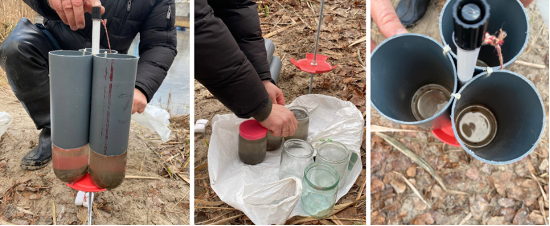
The design incorporates three sedimentation cylinders in one aggregation – the sedimentation trap, which can be suspended in the water column using cables or anchored to the bottom with a pin, depending on the task’s requirements. These samplers are typically deployed in hydrodynamically passive zones of water bodies, and prolonged sedimentation within them allows for the accumulation of sufficient material for analysis.
Using the trap enables not only the assessment of sedimentation rates but also the collection of samples for analyzing the water body’s ecological state. This facilitates more informed decision-making regarding water and sediment quality management in the region.
For instance, such monitoring of suspended substances in the Dnipro River within the city of Zaporizhzhia provided valuable information on sediment dynamics, pollutant distribution, and hydrological conditions.
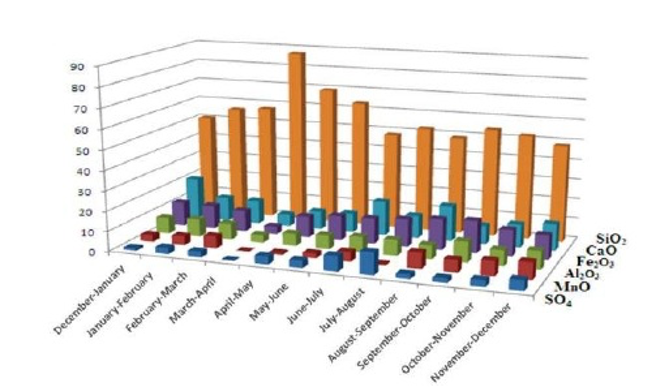
Similar research has also been initiated in the lower course of the Danube River (city of Vylkove) within the framework of the SUNDANSE project.
One of the applied aspects of such studies is, among other things, the assessment of the damage caused to the lower Dnipro River by the destruction of the Kakhovka Hydroelectric Power Plant dam by Russian occupiers.
The SUNDANSE project aims to develop sustainable sediment management solutions for the Danube–Black Sea system, and NECU’s innovation is an important step in this direction.
By Tetiana Herasymova
Funded by the European Union. Views and opinions expressed are however those of the author(s) only and do not necessarily reflect those of the European Union or European Climate, Infrastracture and Environmen Executive Agency (CINEA). Neither the European Union nor the granting authority can be held responsible for them.