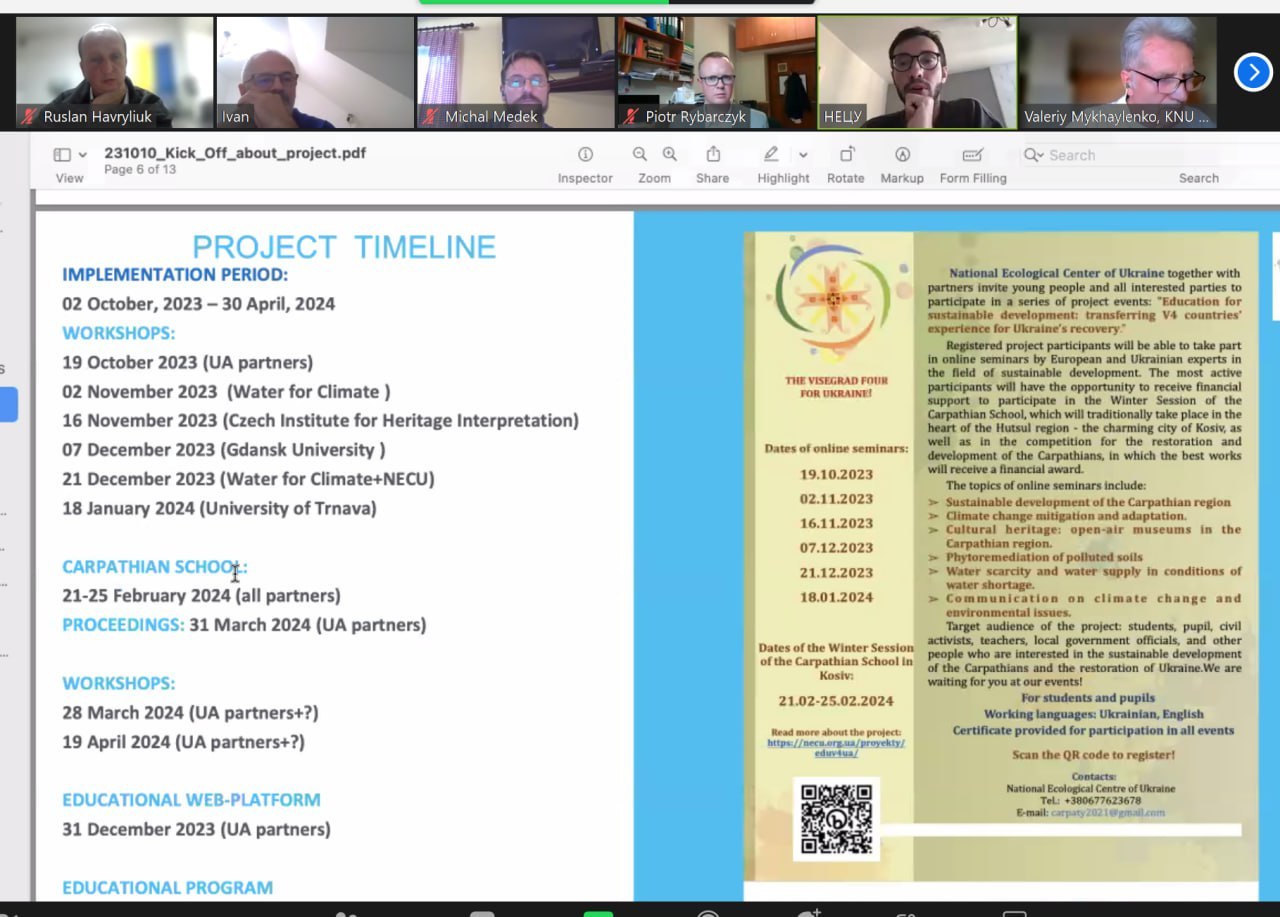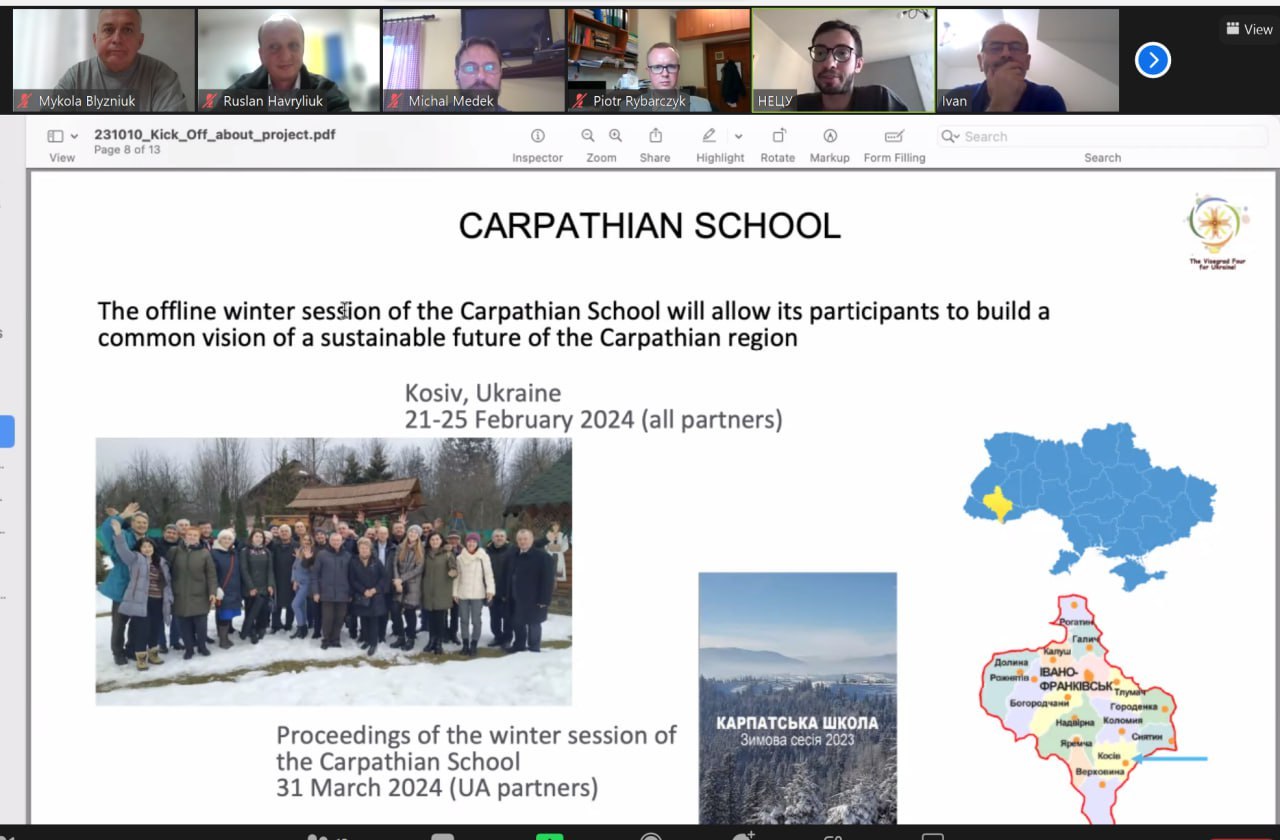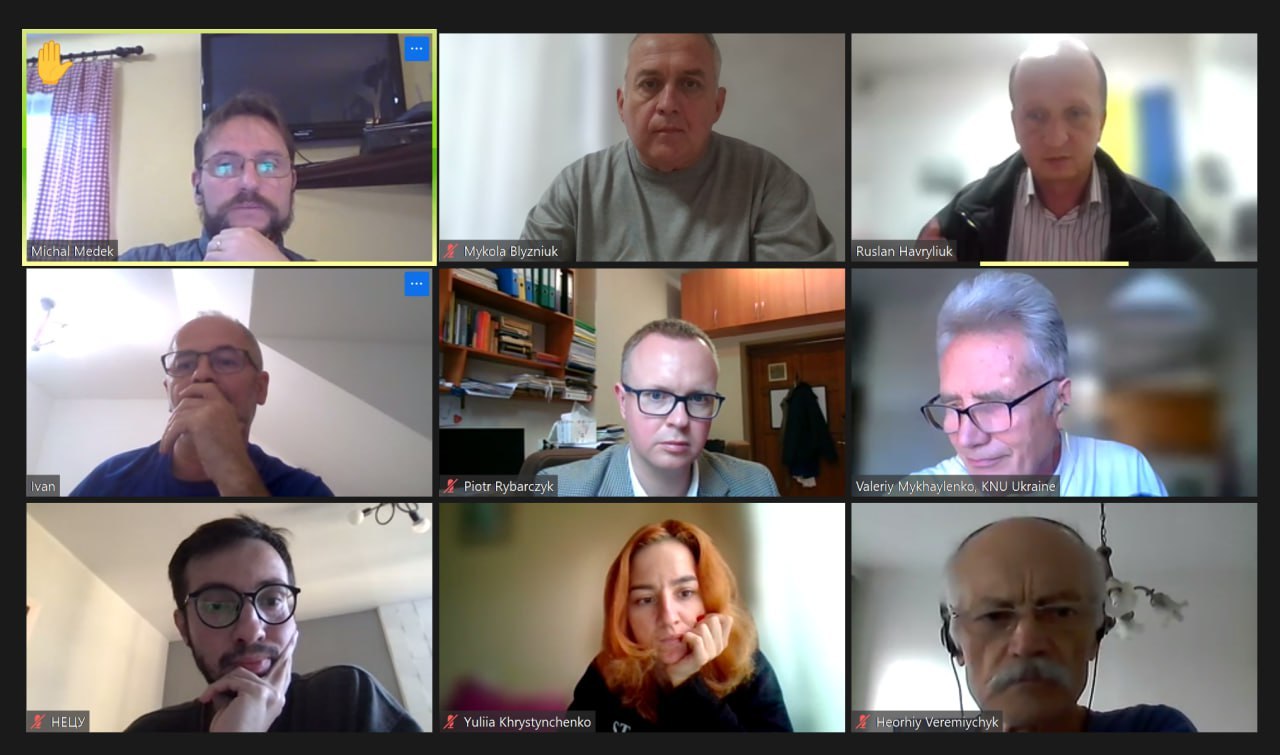
On October 10, 2023, an organizational seminar of the partners of the project “Education for Sustainable Development: Sharing the Experience of V4 Countries for the Recovery of Ukraine” was held.
The seminar included a presentation and a discussion panel with partners. As part of the presentation, Ruslan Havryliuk spoke about what inspired the project and how the idea for its creation came about. Project manager Taras Kovalchuk made a presentation of the project to the partners and provided information and background for the discussion panel. The presentation covered the following issues: project goals, target groups, partners involved, activities planned within the project. The presentation covered the issues related to the Carpathian School, as well as information on the creation of an online educational platform. The partners were provided with an information leaflet and feedback contacts.
The discussion panel with the grant partners helped to identify a common vision of the project’s goals and objectives and discuss a number of organizational issues. As a result of the discussion, the participants received answers to questions about organizational management and the educational process, how to achieve better project results, what experience the students will gain, and how to establish long-term cooperation and expand the scientific network “Education for Sustainable Development of the Carpathian Region.”
The discussion took place in three areas:
- development of the Carpathian Network;
- education for sustainable development;
- organizational and financial management.
Development of the Carpathian Network
The partners were informed that the strategic direction of the grant is “Education and Capacity Building” (Valeriy). He proposes to discuss measures to build a network of education for sustainable development (ESD) among the participating countries and to develop science to strengthen the Carpathian Network (S4C) on the basis of the Carpathian School, which annually organizes winter sessions for students, teachers and activists. At the same time, it calls for the use of the provisions of the Carpathian Convention, Article 13 “Awareness-raising, education and public participation”.
The Ukrainian grant team advocates for the development of scientific cooperation, the search for funding sources, and the transfer of practical experience from V4 countries to students who will have to rebuild the country after the war (Ruslan). He suggests planning to expand cooperation by writing new grant proposals to the V4 Foundation. To coordinate the further work of the partners, it is proposed to create an information channel or group chat, which will be led by a grant manager (Taras).
Educational activities
The partners discussed the format of online webinars and the composition of target groups that will be invited to participate in the educational activities of the Carpathian School.
Target audience. Taking into account the language barrier, the main target group of participants will be students with the required level of English. The partners approved the proposal to invite not only Ukrainian students but also students from partner countries (Ivan). The Ukrainian side also plans to involve students who have left Ukraine and continue their online studies in EU countries (Ruslan).
The partners supported the proposal to develop criteria for evaluating the effectiveness of student participation and to make a gradation of rewards (Ivan, Ruslan, Valerii). They agreed to support the best Ukrainian participants with financial prizes, and to award students from partner countries with certificates (Ivan).
Webinar format. The decision was made to hold webinars in the afternoon (Ruslan) lasting no more than two academic hours (90 minutes). The format of the webinar (lecture, presentation, round table, etc.) is chosen by the partners independently, based on their needs. The thematic areas for each webinar are agreed with the Ukrainian side. The partners will focus on the following topics:
Slovakia (Ivan) proposes an area related to agribusiness. Valeriy emphasizes the complex nature of the problem, using the example of the Grain Agreement and Ukraine’s role in providing agricultural products to the population of countries on the verge of starvation. He proposes to consider the issue comprehensively, perhaps to show the danger of migration of the population of the countries affected by the famine to Europe.
Poland (Piotr) plans to prepare examples that can be used to restore the lands of agricultural firms affected by fires or lands after flooding. An expert with experience in implementing phytoremediation technologies from the Institute of Agricultural Sciences, Warsaw, will be invited to participate. Kakhovka reservoir can be an example for implementation (Valeriy)
The Czech Republic (Michal) focuses its part on social technologies and demonstration of cultural heritage preservation, and can also prepare a case study on protecting international tourist routes from excessive tourist traffic and pollution of mountainous areas with plastic and household waste. The following national parks have experience of such work
Slovakia (Lenka) – proposes to consider the case of climate change in combination with education for sustainable development. Experts will be invited for discussion.
Participation in the activities of the Carpathian School
The partners will prepare educational materials for the participants of the Carpathian School, which is scheduled for February 2024 in a hybrid format. Those wishing to participate live have the opportunity to finance the logistics for one lecturer. The best students who participated in all the webinars will be invited to come to Kosovo with a grant. Students will present their research in pre-selected thematic areas and will be evaluated by project experts. The best papers will be awarded prizes (Ruslan).
Organizational and information management.
In accordance with the grantor’s requirements, you must inform the V4 manager about the state of readiness of the event from 30 to 10 days before it takes place. Otherwise, the costs of the event will not be reimbursed. It is important that information on the status of webinar preparation is received by the grant manager (Taras) no later than two weeks before the scheduled date. If necessary, the date can be adjusted (Taras).
In response to a question about funding and reimbursement of expenses, Ruslan said that the project management is guided by the grantor’s recommendations and coordinates all issues with the Visegrad Group manager. For reimbursement of costs, each partner organization needs to conclude a contract with the NECU, which is the basis for issuing an invoice. Partners must have a certain financial resource to implement the planned activities. The money spent will be reimbursed after the implementation of the planned activities. Financing and reporting will be audited by an auditor. It is necessary to have confirmation of all financial transactions. If the organization is a VAT payer, the issue of VAT refunds is decided by the domestic legislation of the country.