
On 6 June 2023, the Russian occupiers carried out one of the largest terrorist attacks on the territory of Ukraine – they blew up the dam of the Kakhovka hydroelectric power station. Ukrainian officials classify the blast as ecocide and a war crime. Even now, almost a year and a half after the tragedy, it is impossible to fully assess the full consequences of the disaster.
In addition to human casualties and material damage, the dam explosion, which caused significant flooding, led to a humanitarian and man-made disaster, destroyed the landscape, changed ecosystems, polluted aquifers, and fouled the coast and water bodies. This is fraught not only with short-term consequences, but also with long-term ones.
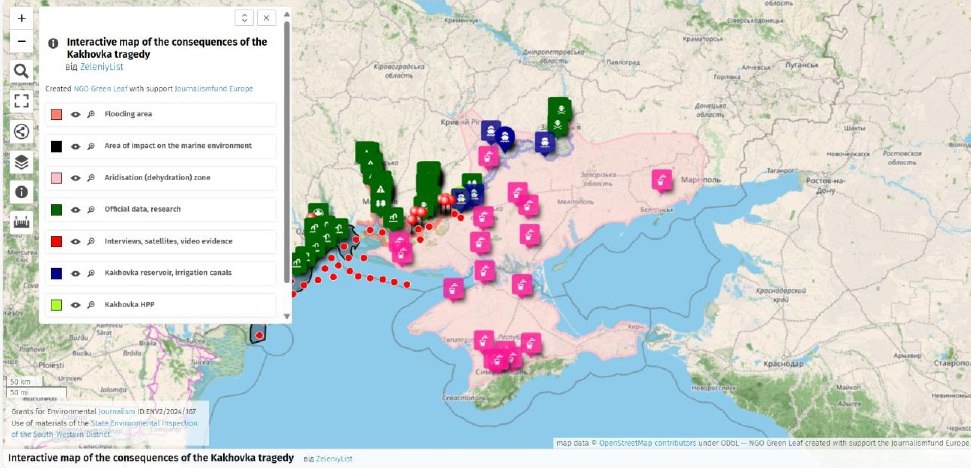
Since the first days of the Kakhovka disaster, the Green Leaf NGO has been collecting information about the destruction of the dam, the devastation of the Kakhovka reservoir and the consequences of this horrific terrorist act by Russia. All collected materials are embedded in an interactive map.
Watch in full screen mode Copy link to map Submit data
Representatives of government agencies, law enforcement, researchers, journalists – everyone who needs up-to-date information on the Kakhovka disaster and its consequences – will find all the relevant facts about this sabotage in one place. In particular, official responses to the organisation’s inquiries, damage estimates, the area of pollution and flooding, and information on the possible range of people involved in the crime. You can also find out how environmentalists assess the consequences of the Kakhovka hydroelectric power station dam explosion, and how the Kakhovka disaster affected the Black Sea and wildlife. In addition to official documents and research reports, the map includes photos and videos, as well as expert interviews. To facilitate searching, all affected areas are divided into three zones: the flood zone, the aridisation (dehydration) zone, and the marine environment impact zone.
The map is not static – we will add new data as we receive information. We are ready to cooperate with everyone who has information to continue to fill the map. In particular, we are ready to provide the code to relevant agencies and organisations, NGOs, and independent researchers to further work together on this important source of information.
Funded by the European Union. Views and opinions expressed are however those of the author(s) only and do not necessarily reflect those of the European Union or European Climate, Infrastracture and Environmen Executive Agency (CINEA). Neither the European Union nor the granting authority can be held responsible for them.